


MRPro – Musculoskeletal Risk Profiling in highways – By Steve Perkins MA CDir FIoD FInstP AFOH, Managing Director, Steve Perkins Associates Limited
The burden of musculoskeletal ill-health
Work‑related musculoskeletal (MSk) disorders are a significant and persistent challenge across all areas of construction, contributing to long‑term ill health, lost working time and workforce sustainability issues. Current symptoms are reported by 40,000 construction workers; 52% of all work-related ill-health in the sector[1]. Construction workers are twice as likely to be disabled and have to leave work over a ten-year period compared to other workers, and 50% more likely than others in manual jobs[2]. When a sample of employers and workers were asked why people leave construction jobs early, almost 50% said this was either due to poor health or simply because the job is too physically demanding for older people[3].
Highways (both high and low speed roads) account for a significant proportion of all UK construction and hence of this burden of MSk ill-health and disability. The work encompasses a wide range of construction, maintenance and operational activities, many of which involve high physical demands, constrained access, time pressure and exposure to adverse environments. These issues are widely known anecdotally across the industry, but no body of evidence existed to act as a driver for change at high level.
Musculoskeletal risk profiling research
 Steve Perkins Associates was asked to design and deliver a Musculoskeletal Risk Profiling (MRPro) research project across the high speed Strategic Road Network (SRN) and the whole of National Highways’ supply chain to improve understanding of these hazards, by developing an evidence‑based profile of MSk risk.
Although there may be some task undertaken on the SRN which are not applicable in the Local Authority sector, the majority read-across directly. The results of MRPro will be relevant to Council Highways Departments, Contractors and Designers.
Wide variety of hazardous tasks
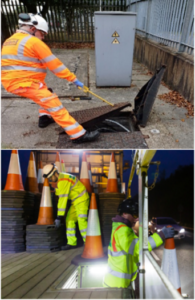 Highways work includes construction, renewal, maintenance and operational activities such as pavement and structures work, traffic management, vegetation control, recovery and ground investigation.
Some tasks are recognisably high risk: lifting chamber covers, carrying materials, laying kerbs, breaking out concrete, installing crash barriers and erecting scaffolding. Others are less obvious outside the sector, including cone handling, placing roadside signs, carrying equipment across embankments, or working in restricted spaces. Some are specialist activities; others are repeated daily across the network by large numbers of workers.
A task with a moderate individual risk but very high frequency may represent a greater overall burden than a more severe but uncommon task.
Methods and participation
The methodology was multi-stage. It began with stakeholder analysis and communication planning, followed by focus groups organised around the highways work breakdown structure. These generated a broad list of tasks perceived to carry musculoskeletal risk. Surveys were then used to refine and prioritise those tasks. Selected activities were assessed using the HSE’s MAC, ART and RAPP tools, supported by photographs and video. Findings were subsequently weighted using task frequency and estimated population exposure.

Significant participation across the sector was needed to provide credible results:
80 champions were recruited from across the sector to act as conduits for information and recruiters for focus groups.- 135 individuals (H&S and operational managers) participated in 23 different focus groups themed by discipline, generating 100 perceived high-risk tasks.
- There were 10 different versions of e-survey, targeted at different work areas (each covering a number of focus group disciplines). These were targeted at frontline workers and those who had previously worked in frontline roles. Based on 285 responses we narrowed the list of high-risk tasks down to the 45 seen as most problematic.
- Estimates for how many times tasks are performed each day (or how long for) were made using focus group data. Estimates of how many workers perform these tasks each day across the strategic road network were made based on a short questionnaire issued to National Highways’ supply chain partners through their Commercial Managers network.
- Overall, some 100 different companies were involved in the research from PLCs to SMEs, covering principal and sub-contactor civils, specialist contractors and designers.
Categorising risk to target solutions
A useful feature of the findings is the broad distinction between different categories of musculoskeletal risk. Some were effectively historic and harmful, in that they had been designed into existing assets and working environments. Others were embedded and enduring in established methods of working, such as repeated cone handling or manual operations that remain routine. Others again were avoidable but accepted, where lower-risk methods already exist but are not used consistently.
Historic risks will require long-term design and asset management responses. Embedded risks may require redesign, innovation or new equipment. Avoidable risks may be more amenable to standardisation, procurement requirements, supervision or better implementation of current good practice.
Prioritisation and risk scoring
The MRPro report now raises the question: how should organisations respond once a broad risk profile has been established? There is no single answer. One option is to focus on tasks with the highest apparent severity. Another is to prioritise tasks with high frequency and broad workforce exposure. A third is to address relatively accessible problems first where improvements are more straightforward.
In practice, some combination of these approaches will be needed. Risk profiling is useful here because it allows decisions to be informed not only by task severity, but also by how widespread the exposure is and how feasible control is likely to be.
The report presents the overall risk profile in tabular form highlighting a number of factors:
- ‘Final Score’ which combines how hazardous a task is with how many times it is done each day.
- ‘Population exposure’ which is an indicator of how many people are doing this task each day across the strategic road network.
- ‘Worker opinion’, which uses information from the survey to show the percentage of people who considered a task to be medium or high risk.
- The table also shows where the HSE might categorise a task as carrying a possible or probable risk of significant injury, based on guidance provided to HSE inspectors.
The table is sorted by ‘Final Score’ and ‘Population exposure’, so that the tasks at the top are those which have the highest risk and are done by the most people. These are the tasks where high-level intervention (e.g. industry level) will have the greatest impact. Where hazardous tasks are carried out at a lower frequency or by a smaller number of people, the risk still needs to be managed: but it is more likely that this will be done at a local level or by those working within a specialist area.
The ‘Possible Solutions’ shown in the table are largely from discussions in the focus groups and from survey responses. This is not a comprehensive list of the possible ways to address each task. In all cases, the aim should be to implement solutions which are as far up the hierarchy of control as possible. An extract of the first page of the table is shown overleaf as Table 1.
There are also 11 appendices, listed overleaf, covering detailed risk scoring records for all the assessed high risk tasks with information on evidence of harm, specific challenges, control measures and good practice, and scope for improvement.
• Common tasks
• Pavements
• Structures
• Enabling works
• Technology and signage
• Traffic Management
• Archaeology
• Vegetation management
• Ground investigation
• Scaffolding
• Recovery
“A lot of the guys will look at it and go, yeah, I can handle that. It’s no problem. Two of us, grab this and I’ll grab that end.”
(Focus group participant)
“Numerous occasions we’ve broken hydraulic lifting or chains just to lift up the chamber because they’ve either seized or the weight of them.”
(Focus group participant)
“We supply our guys with cradles but if I’m honest…they don’t see them as something that’s beneficial until their back goes.”
(Focus group participant)
“I can no longer physically pick up a jug and rotate it through its full range of motion when there’s weight in it, because my wrists are knackered… I have sciatica… my right shoulder, that’s completely knackered.”
(Focus group participant)

Table 1 – First page extract from the overall risk profile table
The report also highlights the problem of under-recognised musculoskeletal harm. Survey and focus group findings indicated that work-related pain was common, but not always reported. It was often seen as part of the job, part of ageing, or not serious enough to mention.
“Don’t think it won’t creep up on you because it does…it might not be today or tomorrow you feel the pain, but in three years, five years, ten years, you’ll feel the pain. And believe me, that soon comes…”
(Focus group participant)
Good practice case studies
In addition the report includes six good practice case studies to illustrate how MSk risk reduction can be delivered in practice:
- Cone laying – isolation through mechanisation
- Dry stone walling – improved planning and job organisation
- Robotic hydro demolition – isolation through mechanisation
- System approaches to reduce scaffolding risk – substitution
- Reducing risk in archaeology – task specific tools and training
- Pre-cast concrete for low level retaining structures – substitution through off-site manufacturing
Download the full report for free
The report is now in the public domain and is freely available to download from:
https://www.steveperkinsassociates.com/resources/
For more information about MRPro and musculoskeletal risk contact us at:
enquiries@steveperkinsassociates.com
[1] HSE. Construction statistics in Great Britain, 2024 [Internet]. 2024 [cited 2025 Jun 26]. Available from: https://www.hse.gov.uk/statistics/assets/docs/construction.pdf
[2] Arndt V, Rothenbacher D, Daniel U, Zschenderlein B, Schuberth S, Brenner H. Construction work and risk of occupational disability: a ten year follow up of 14 474 male workers. Occup Environ Med. 2005;62:559–66. doi:10.1136/oem.2004.018135
[3] Rye Tait. Fuller working lives in construction [Internet]. 2018 [cited 2025 Aug 8]. Available from: https://www.citb.co.uk/media/2bylp3yw/fuller-working-lives-in-construction.pdf
(Images – Steve Perkins Associates)