

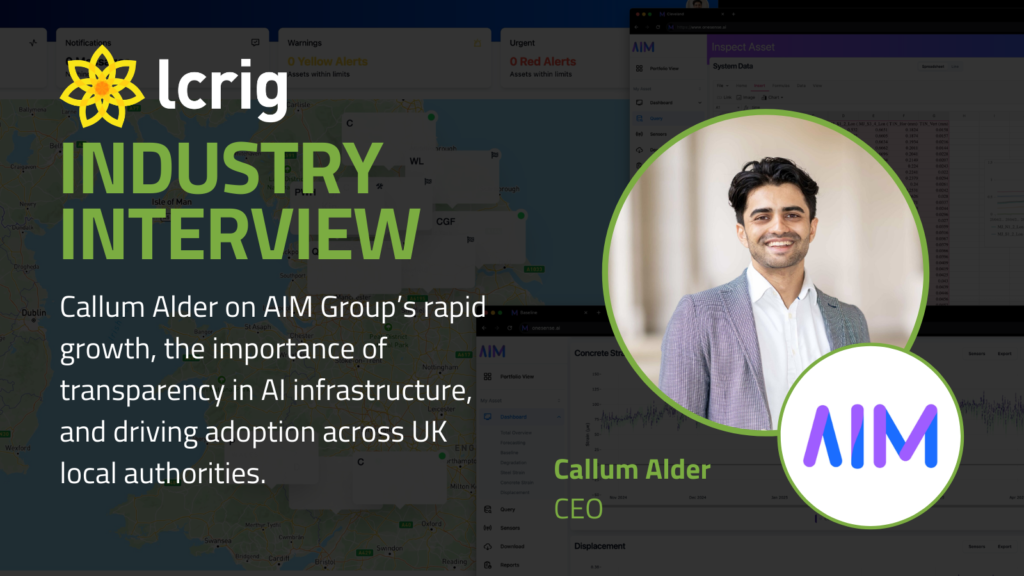
In this latest member interview, we speak with, Callum Alder, CEO at AIM Group, pioneers of an AI-powered predictive monitoring platform that is helping prevent structure closures and significantly reduce maintenance costs. By using data that infrastructure owners are already collecting, AIM is transforming how ageing assets are managed across highways and major structures.
Callum shares how AIM has scaled rapidly over the past year, why transparency is critical when deploying AI in infrastructure, and what needs to change to accelerate adoption across UK local authorities.
Unlocking the Value of Infrastructure Data
The UK’s infrastructure is ageing, and the cost of managing it continues to rise. For AIM Group, the challenge isn’t a lack of data, it’s how that data is used.
“There’s a much better way to manage ageing and critical infrastructure,” Callum explains. “We already collect huge amounts of sensor data from assets like bridges. The opportunity is to use that data properly, applying machine learning to help asset owners make smarter, earlier decisions.”
Rather than relying solely on periodic inspections or reactive interventions, AIM’s platform analyses structural monitoring data to predict emerging risks. The result is fewer unexpected closures, more targeted maintenance, and significant cost savings.
“There’s tremendous value sitting in that data,” he adds. “We just need the right tools to extract it.”
Building Trust in AI
With AI becoming an increasingly common, and sometimes misused label in the market, transparency is central to AIM’s approach.
“When people hear AI, they often think of tools like ChatGPT,” Callum says. “That’s generative AI. What we do is fundamentally different. We’re analysing physical sensor data to assess structural performance.”
Critically, AIM does not give an answer and expect engineers to accept it.
“We don’t just provide a prediction; we provide a prediction with a confidence level. If the model isn’t fully confident, that’s clearly communicated. Engineers can see not just the output, but how much trust to place in it.”
That quantified confidence is essential when decisions can involve public safety and assets worth billions of pounds.
From Demonstrator Projects to Scalable Delivery
Since appearing in the Start-Up Zone at the 2025 LCRIG Innovation & Learning Festival, AIM Group has grown fourfold. The volume of data processed by its platform has increased dramatically, and the business has expanded across multiple asset types.
One major milestone has been working with the team on the Queensferry Crossing, home to one of the most powerful monitoring systems for bridges.
“That project demonstrates the scale we can operate at,” Callum says. “We’ve moved from isolated demonstrator projects to something genuinely scalable. Now it’s about scaling compute and data, not reinventing the wheel each time.”
Beyond Queensferry, AIM is scaling this approach across some of the UK’s most challenging, safety-critical assets, working with local authorities and delivery partners including WSP, Mott MacDonald and BEAR Scotland.
The Challenge of Local Authority Adoption
While AIM is working with UK local authorities including Blackpool and Derby, Callum acknowledges that wider adoption remains complex.
“Councils like Blackpool and Derby are doing an incredible job under real constraints,” he explains. “They’re balancing immediate safety responsibilities with long-term stewardship. It isn’t always easy to access the funding and the tools that make preventative decisions straightforward, even when the long-term case is clear.”
Both Blackpool and Derby, he notes, shared something important: forward-looking teams who were deeply committed to their communities, proactive, and open to doing things differently.
“It wasn’t just about doing things better,” he says. “They had problems that existing approaches weren’t solving. That urgency creates momentum.”
“It was genuinely refreshing,” he adds. “They weren’t only asking, ‘How do we fix today’s problem?’ They were asking, ‘How do we prioritise the right intervention at the right time, and justify it with evidence?’ That’s exactly what AIM is here to enable.”
He believes the next step is to make it easier for proactive councils like these to adopt solutions like AIM, and he is encouraged by the fact that more councils are now asking the same long-term questions. “That shift towards preventative thinking is a really positive sign,” he says. “It’s how we protect the UK’s infrastructure and get better value from every pound spent.”
A Word of Caution on ‘AI’
For authorities considering predictive AI solutions in highways, Callum offers straightforward advice:
“Know what you’re buying. AI is a very black box technology, and there’s a lot of nuances. I see many products labelled as AI that simply aren’t.”
In fact, he suggests AI should only be used when necessary.
“If a problem can be solved without AI, that’s often better. You should only reach for AI when the problem is so complex that nothing else will do.”
Transparency around methodology, validation, and data use should be non-negotiable.
Scaling the Future of Asset Management
For AIM Group, the next 12 months are focused on one thing: scale.
“New sectors, new industries, new countries,” Callum says. “The technology works. Now it’s about expanding its reach.”
With infrastructure budgets under pressure and asset lifespans stretched further than ever, predictive monitoring offers a shift from reactive maintenance to proactive management, unlocking the value in data that is already there, waiting to be used.
Find out more about AIM Group by visiting their website and LinkedIn page.
Thank you to Callum and the team at AIM Group for sharing their insights.