

“If the services are not better, then we probably don’t deserve their confidence.”
That challenge from Zenzic Programme Director Mark Cracknell sets the tone for a Highways Voices discussion that asks what connected and automated transport must deliver for the people using it – and what is stopping the industry getting there.
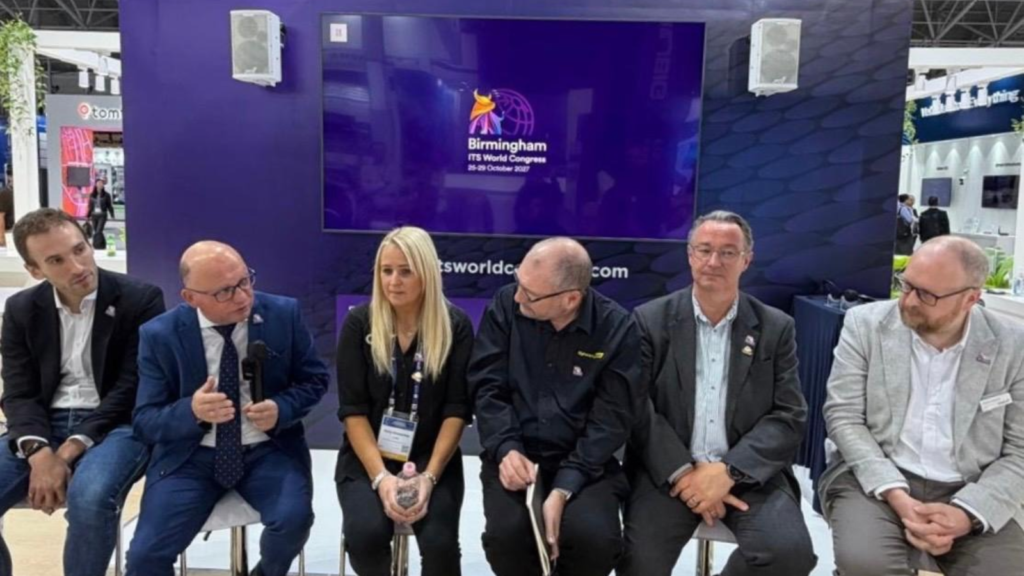
Recorded at the UK and ERTICO – ITS Europe Pavilion at the ITS World Congress in Gangneung, South Korea, Paul Hutton brings together five leading voices from government, industry and local highways to explore how connectivity can make journeys safer, simpler and more reliable. For anyone developing, buying or deploying transport technology, the conversation explains where the opportunities lie, which barriers need tackling and why better technology alone will not guarantee success.
Mr Cracknell tackles a crucial distinction: why a self-driving vehicle must operate safely without relying on connectivity, but needs connectivity to become part of a useful, coordinated transport service. He also explains why public confidence requires education, first-hand experience and services that improve on what people already have. Recalling his own first autonomous journey, he says: “At the end of it, I got out and thought, ‘That was a bit boring.’” He explains why that was a good result.
The Department for Transport’s Head of Road Infrastructure Technology, Darren Capes, warns that getting the regulatory framework right now matters if automation is to deliver public value.
“There is a real danger, as we see pressure from industry and especially very large industry, that we move into a world where we don’t have enough regulation, where we end up with results that we don’t really want,” he says.
Listen to hear how government is approaching connected services, why common standards matter and where automation is already delivering benefits beyond passenger transport. Mr Capes also offers a clear principle for anyone considering investment: “Technology isn’t an end. Technology is a tool.”
For local authorities, the immediate challenge is finding the capacity and expertise to turn those possibilities into everyday improvements. Local Council Roads Innovation Group Managing Director Kerry Winstanley identifies the practical gaps around data, procurement and skills.
“Authorities are open for this and are crying out for this support,” she says.
Ms Winstanley also reveals that LCRIG is taking on secretariat responsibilities for the UK Roads Leadership Group, including the UK branch of PIARC, the World Road Association. Hear how those connections, alongside its work with the Automated Mobility Network, can help councils share experience and adopt new approaches.
ITS UK Chief Executive Max Sugarman explains why the policy environment is creating fresh opportunities for suppliers, with government increasingly looking to transport technology businesses to help deliver its ambitions.
Documents are “now actually looking to the ITS sector to get to work on these things… at a level which I’ve not seen in the past”, he says. He discusses how businesses can move from promising ideas towards commercial success, access opportunities and explore overseas markets.
Meanwhile, ERTICO – ITS Europe Chief Executive Officer Joost Vantomme makes the case for sharing vehicle and infrastructure data to improve safety: “It’s not negotiable. You don’t negotiate on safety.”
He also looks ahead to Birmingham 2027, explaining how demonstrations, discussions and collaboration can make emerging technology tangible. His message is simple: “Seeing is believing.”
Listen to this Highways Voices special to understand what connectivity means for your organisation – from the support councils need and the opportunities suppliers can pursue to the standards, services and public confidence that will determine what happens next.
Listen to the full podcast here:
Subscribe to Highways Voices free on Apple Podcasts, Spotify, Amazon Music, Google Podcasts or Pocket Casts and never miss an episode!