

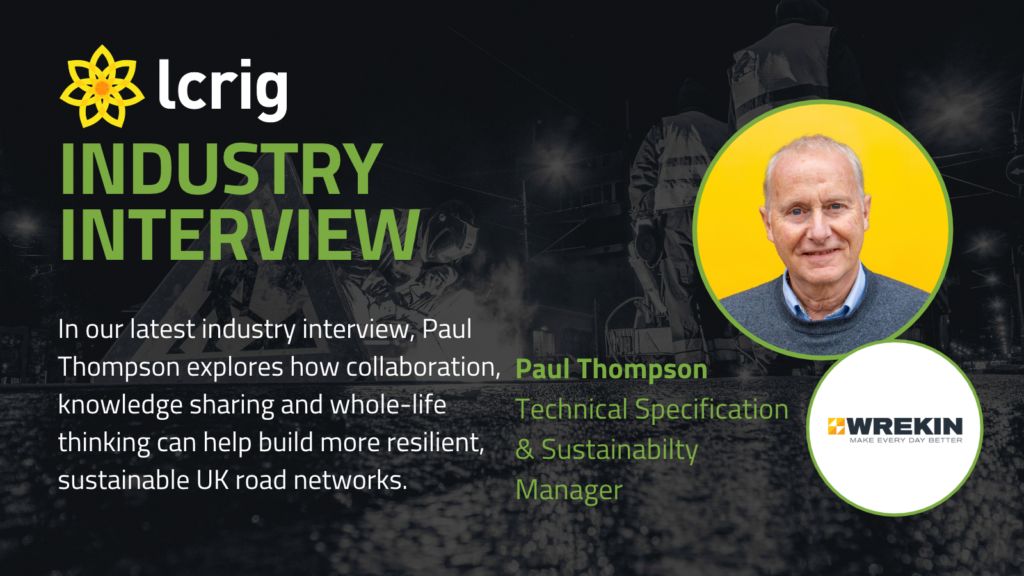
Following the publication of its latest white paper, the Evolving Needs of UK Roads, Paul Thompson, Technical Specification and Sustainability Manager at Wrekin, discusses how collaboration, knowledge sharing and whole-life thinking can help deliver safer, more sustainable and cost-effective road networks.
By looking beyond initial purchase costs and considering long-term performance, installation quality and environmental impact, the sector has an opportunity to improve resilience and achieve better value from investment in local roads.
Q. What inspired you to produce the white paper, and what did you hope it would achieve?
A. We’re increasingly seeing the wider industry looking to the supply chain to contribute ideas and share its experience of how things can evolve. Our role now goes much further than simply supplying products. We are part of the wider value chain and have knowledge and experience that can help inform how networks are managed.
The aim of the white paper was to prompt discussion and debate among organisations responsible for managing the road network, as well as those whose activities have an impact on it, including utility companies.
Ultimately, we want to encourage people to look beyond short-term decisions and consider the longer-term strategic choices that can improve network resilience. Resilience is a term used frequently, but it’s important to make the connection between improved resilience, better asset performance and the potential to reduce whole-life impact and cost.
We hope the white paper will help start those conversations.
Q. What changes are you seeing across the sector that are helping local authorities build more resilient road networks?
A. One of the most encouraging developments is that organisations are becoming more open to involving the wider value chain and inviting suppliers to share their knowledge and experience.
We work across several different sectors, which gives us the opportunity to bring insight from organisations managing similar assets in different environments.
Take carriageway ironwork and access covers, for example. Regardless of who owns or manages the asset, many of the fundamentals are the same. The principles of specifying, installing, maintaining and operating the product don’t fundamentally change.
So why not share the learning and experience gained elsewhere?
We’re increasingly seeing organisations recognise the value of those conversations and become more willing to bring people like us into discussions about how that experience can be applied to their own networks.
Q. How can the multi-year funding settlement support a more proactive, right-first-time approach to road maintenance?
A. My experience of the water industry is a useful comparison. Water companies operate within five-year Asset Management Periods (AMPs), which give them greater visibility of future funding and allow them to make more strategic investment decisions.
That longer-term certainty creates the confidence to invest in resilience and improved asset performance, rather than continually responding to problems as they arise.
Greater funding visibility gives local authorities the opportunity to prioritise what matters most for their networks and build resilience into their investment decisions.
We’ve seen examples where taking a longer-term approach can reduce repeated reactive repairs, which often end up costing more. It’s about giving authorities the confidence and flexibility to think beyond the immediate maintenance requirement and consider what will deliver the best outcome over the life of the asset.
Q. Can you give an example of where this approach is already making a difference?
A. Although our examples relate to ironwork, our collaborative relationships with organisations in the utilities sector demonstrate what’s possible.
It starts with getting the fundamentals right: specifying the right product for the right application and having a clear specification covering materials, workmanship and installation requirements.
Bringing those elements together creates a more consistent and systematic approach to asset management.
As I’ve mentioned, the principles are transferable. What has been developed within the utility sector could equally be adopted by local authorities to improve the performance and longevity of their own highway assets.
Q. How important is collaboration between local authorities, contractors, utilities and the wider supply chain in improving road network resilience?
A. It’s fundamental. Collaboration is about sharing best practice and learning from the experience others have already gained.
We’re increasingly seeing a more systematic approach to managing ironwork develop across the industry. It started within the water sector and has since expanded into telecommunications. We’re now seeing local authorities beginning to adopt similar approaches.
Our ambition would be to see a consistent approach adopted across the country, from Scotland to Cornwall, because it’s recognised as best practice and delivers the best whole-life performance from these assets.
There is no reason why organisations should have to learn the same lessons independently when that knowledge and experience already exists elsewhere.
Q. Where are you seeing innovation and new approaches making a difference in the sector?
A. Material and product innovation will always continue, but I think some of the most significant opportunities are around changing the way we think about and approach asset management.
Innovation isn’t necessarily about developing a new product. It can be about challenging established processes and being prepared to do things differently.
Collaboration and knowledge sharing are a huge part of that. We also need to be willing to get things wrong occasionally, learn from those experiences and adapt. It’s about being prepared to challenge existing practices rather than simply repeating them.
I think process innovation and changes in organisational thinking will become increasingly important, particularly in how organisations plan to repair, replace and renew their assets.
Q. What role do organisations such as LCRIG play in sharing best practice and encouraging new approaches?
A. For an organisation such as Wrekin, being part of LCRIG gives us a voice at the table and an opportunity to engage directly with key stakeholders across the sector.
It allows us to participate in wider industry debates and contribute our experience, while also learning from the challenges faced by local authorities and other organisations.
Events such as the LCRIG Innovation and Learning Festival and Strictly Highways provide valuable opportunities for people to come together and discuss how we can maximise whole-life asset performance, improve road conditions and work more effectively across the industry.
It’s about creating an environment where those conversations can happen and where people can explore what needs to change to achieve better outcomes.
Q. The white paper also highlights the importance of skills and installation quality. What opportunities are there to build capability and raise standards across the workforce and supply chain?
A. What’s encouraging is the increasing number of opportunities we’re being given to share our experience, whether through CPD sessions or by participating in events such as the Innovation and Learning Festival.
These opportunities allow us to help people understand the relatively simple changes that can make a significant difference.
All too often, we see specifications for our products referencing a standard that relates primarily to manufacturing. While that establishes certain performance requirements, it doesn’t necessarily consider how the product will actually be used or installed.
We need to look beyond the minimum product performance requirements and consider the wider installation process. That means thinking about materials, workmanship, planning and preparation, as well as the product itself.
Bringing all these elements together can help create a more comprehensive, repeatable specification that can be applied consistently across an entire network.
These might seem like relatively small changes, but they can have a significant impact on long-term asset performance.
Q. Looking ahead, what gives you the most optimism about the future of the UK’s local road network?
A. For me, it comes back to the growing recognition of whole-life thinking.
There is a much greater understanding now of the relationship between whole-life cost and performance, compared with simply focusing on short-term purchase price.
A more resilient network is ultimately a safer network, and investing in better-performing assets can help reduce costs over a longer period. We’re seeing more organisations recognise that connection and become increasingly willing to have conversations about whole-life performance and impact, including environmental considerations and the carbon associated with maintenance.
Q. Finally, what’s the one message you’d like readers to take away from the white paper?
A. Be open to inviting your value chain into the conversation.
There is a huge amount of knowledge and experience built up across the industry over many years, and much of it is transferable between sectors.
If an approach has worked within the water industry, there’s no reason why those principles can’t be applied to local authority road networks.
We need to move towards a more collaborative approach, where organisations are willing to share what they’ve learned and make better-informed, longer-term decisions.
A big thank you to Paul at Wrekin for sharing his insights and highlighting the importance of collaboration, whole-life thinking and knowledge sharing in building more resilient local road networks.