

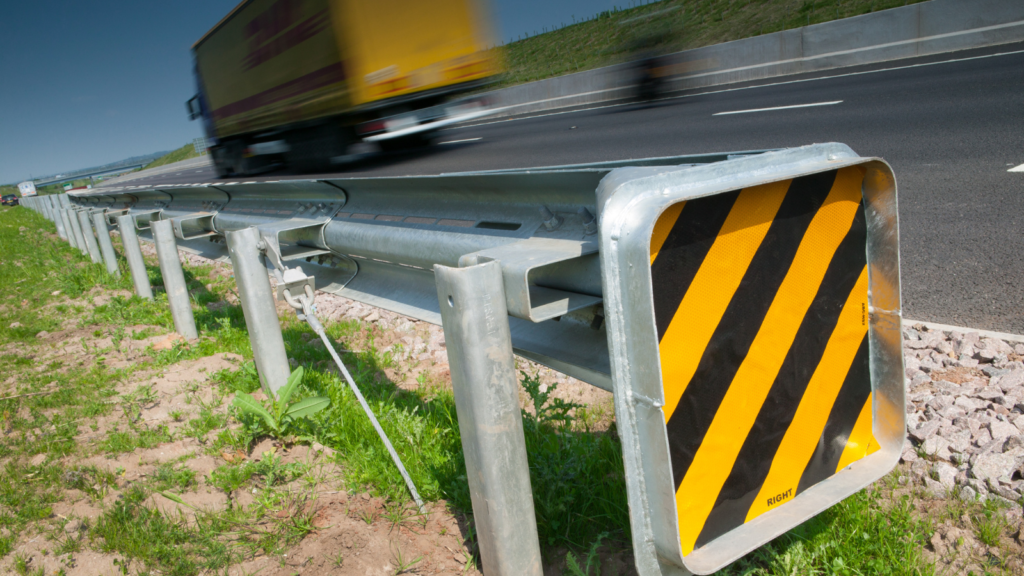
Hill & Smith VRS has shared insight into the role and classification of Vehicle Restraint System (VRS) terminals, highlighting their importance in improving road safety and ensuring compliance with current standards.
Installed at the ends of barrier runs, VRS terminals are designed to anchor the safety barrier system and reduce the risk of injury to vehicle occupants in the event of an impact. Their specification and performance classification play a key role in determining suitability for different road environments and speed conditions.
There are four performance classifications for VRS terminals, with P1, P2 and P4 most commonly specified:
- P1 – Non-energy absorbing terminals suitable for roads with a speed limit below 50mph, often referred to as “ramped terminals” due to their design configuration.
- P2 – An energy-absorbing terminal suitable for roads with a speed limit below 50mph where vehicles approach the terminal head-on.
- Particularly effective where space is constrained, often allowing greater usable lengths of standard guardrail to meet minimum Length of Need (LoN) requirements when used in place of a P1 terminal.
- P4 – An energy-absorbing terminal suitable for roads with a speed limit of 50mph or greater, offering enhanced protection for higher-speed environments.
Due to their application on higher-speed roads, P4 terminals are typically longer than P2 terminals.
What does DMRB guidance state?
In accordance with CD 377, the following clauses apply (paraphrased):
- ≥50mph and facing oncoming traffic: T110 / T110‑1 (PD CEN/TS 1317‑7) or P4 (DD ENV 1317‑4:2002) – see clause 6.3.
- ≥50mph and not facing oncoming traffic: minimum T80/3 or P1– see clause 6.4.
- <50mph: minimum T80/3 or P1– see clause 6.5.
Key Design Considerations
- On two-way single carriageways, terminals at both ends of a safety barrier are considered to face oncoming traffic.
- Terminals that do not face oncoming traffic include:
– Trailing ends of barriers on dual carriageways
– Trailing ends on one-way roads
– Leading-end terminals located behind a sufficient length of safety barrier
- Hazards located behind terminals should, as best practice, be kept outside the terminal’s displacement zone class.
- Terminals must be installed outside the LoN – see CD 377 figure 3.24.
- Products tested in accordance with PD CEN/TS 1317‑7 and/or DD ENV 1317‑4:2002 cannot be CE or UKCA marked.
Solutions
Hill & Smith VRS Ltd offers a comprehensive range of terminal offerings, including:
Proprietary P1 terminals – Single and Double-Sided FlexBeam Terminals

Official UK distributor for Valtir P2 and P4 Trend Terminals, plus the P4 ABC Terminal


Additional solutions including the SafeEnd and ERMES Terminals which are compatible with a range of Guardrail products
This breadth of offering allows Hill & Smith VRS to accommodate a wide variety of site constraints, road environments and design challenges.
If you or your team would like to build deeper knowledge around VRS design, testing, and standards, visit the website.
(Images – Hill and Smith VRS)