

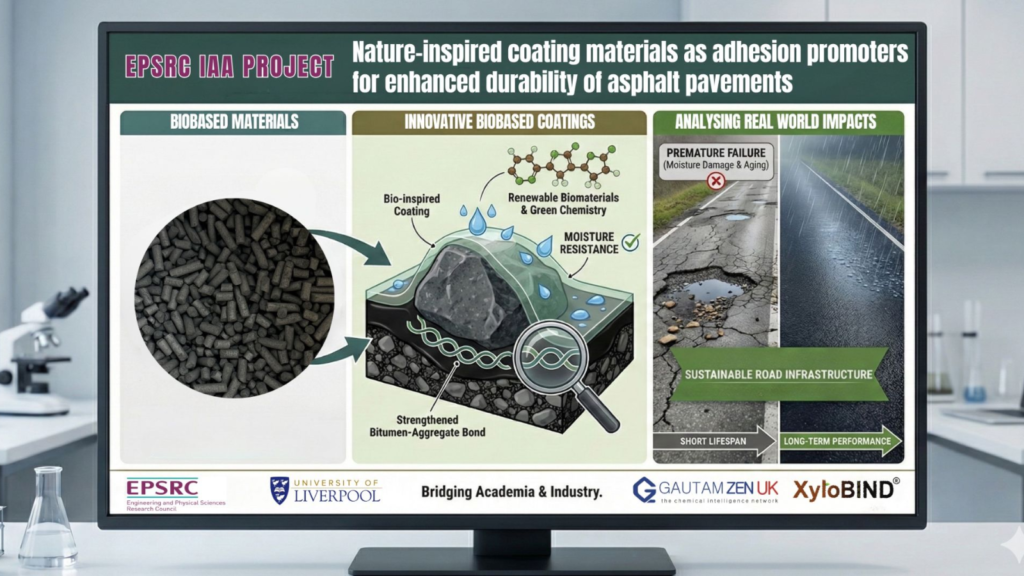
The University of Liverpool has collaborated with industry partner Gautam ZEN UK, specialists in renewable biomaterials, green chemistry, and sustainable solutions for the construction sector, to address one of the UK’s most persistent infrastructure challenges: asphalt pavement durability.
Challenge
The UK road network plays a vital role in the movement of people and goods and represents infrastructure valued at approximately £750 billion. A persistent challenge in asphalt pavements is inadequate adhesion between the bituminous binder and mineral aggregates. Poor adhesion accelerates pavement deterioration, contributing to surface defects such as stripping and pothole formation. Potholes, in particular, have become a significant issue in the UK’s ageing road infrastructure, with damage levels reaching a five-year high and prompting the government to invest £8.3 billion in road repairs.
Aim
This project aims to investigate the feasibility of nature-inspired coating materials as adhesion promoters for asphalt applications. The coatings will be applied directly to mineral aggregates to enhance binder aggregate adhesion, to improve pavement durability, resilience, and service life.
Collaboration
The Engineering and Physical Sciences Research Council (EPSRC) Impact Acceleration Account (IAA) project is being delivered through a collaboration between the University of Liverpool and Gautam ZEN UK Ltd. Gautam ZEN UK contributes expertise in renewable biomaterials, green chemistry, and sustainable construction solutions. The partnership combines academic research capability with industrial know-how to support the translation of laboratory innovation into real-world road infrastructure.
Objective
By developing more durable and sustainable asphalt materials, the project directly supports the National Highways Net Zero Plan, contributing to the delivery of longer-lasting, lower-carbon transport infrastructure across the UK.
For more information, visit Gautam ZEN UK’s website or LinkedIn page.
(Image – Gautam ZEN UK)