

Severe weather is no longer a seasonal challenge for local authorities and highways teams. Flooding, extreme rainfall, freeze-thaw cycles and unseasonal storms are now a year-round reality, placing increasing pressure on networks, budgets and operational teams.
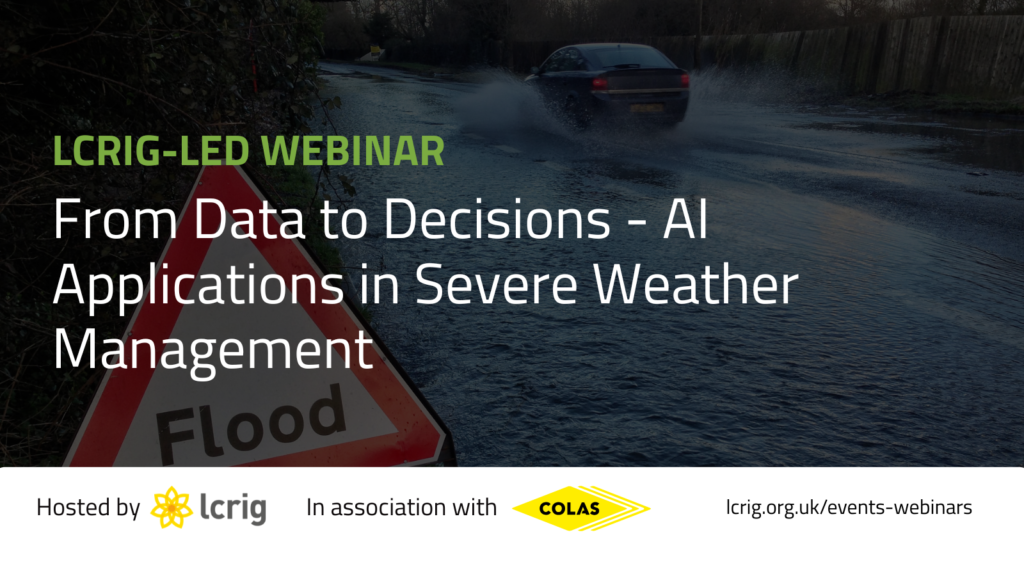
In December, LCRIG brought together local authority leaders and industry experts for a member-exclusive webinar exploring how artificial intelligence is already being used to improve how we monitor, predict and respond to severe weather events.
The webinar and accompanying AI Mini-Guide were delivered by LCRIG, in collaboration with Colas.
From Data to Decisions – AI Applications in Severe Weather Management looked beyond the hype to focus on real-world applications, practical lessons and the realities of adoption.
Why this conversation matters now
Local authorities are facing:
- Greater unpredictability in weather patterns
- Increased public expectation and scrutiny
- Limited resources and skills capacity
- Growing pressure to act earlier, not just respond faster
AI has the potential to support better decision-making, but only when it is applied in a way that is transparent, practical and aligned to operational realities.
This webinar focused on exactly that.
A local authority perspective
Opening the session, Carol Valentine, Highways Drainage Manager in Highways and Transportation at Kent County Council, set out the real-world impact of severe weather on local highway networks.
From infrastructure damage and budget pressure to the human impact of flooding on residents and businesses, Carol highlighted why better forecasting, smarter use of data and improved collaboration with industry are becoming essential.
Rather than focusing on theory alone, the discussion focused on how AI can support the day-to-day challenges faced by councils.
Where AI is already making a difference
The panel shared practical examples of how AI is being applied today, including:
- Automated detection and alert systems to identify changing road and weather conditions
- Computer vision using highway and road weather cameras to monitor surface conditions in real-time
- Predictive flood forecasting and monitoring, combining physics-based models, sensor data and machine learning
- Targeted, proactive interventions, helping teams act earlier and deploy resources more effectively
Crucially, speakers were open about the limitations as well as the benefits, emphasising the importance of data quality, interpretation and human oversight.
Learning from live projects
The webinar featured insights from organisations actively testing and deploying AI in operational environments:
- Colas, sharing insight into AI pilots within its UK business and the use of AI-powered tools to support real-time monitoring and response
- Destia, sharing experience from Finland on AI-enabled winter maintenance and road condition monitoring
- Previsico, demonstrating how AI and modelling are being used to provide property-level surface water flood forecasting
These case studies showed how AI can support faster, more confident decision-making when time and accuracy matter most.
Adoption, collaboration and capability
A recurring theme throughout the session was that successful adoption is not just about technology.
Speakers highlighted:
- The need for collaboration between local authorities, suppliers and innovators
- The challenge of limited in-house data and analytics capacity
- The importance of tools that translate complex data into clear, actionable insights
This is where shared learning, guidance and trusted partnerships become critical.
Watch the full webinar and access the AI Mini-Guide
This blog only scratches the surface of the discussion.
LCRIG members can:
Both resources explore the topics in much greater depth, including detailed examples, panel discussion and practical takeaways for local authorities and highways professionals.
Log in to the LCRIG MEMBERS AREA TO ACCESS THE RECORDING AND GUIDE
If you’re not yet a member but would like access, you can find out more about joining LCRIG on our membership page.