

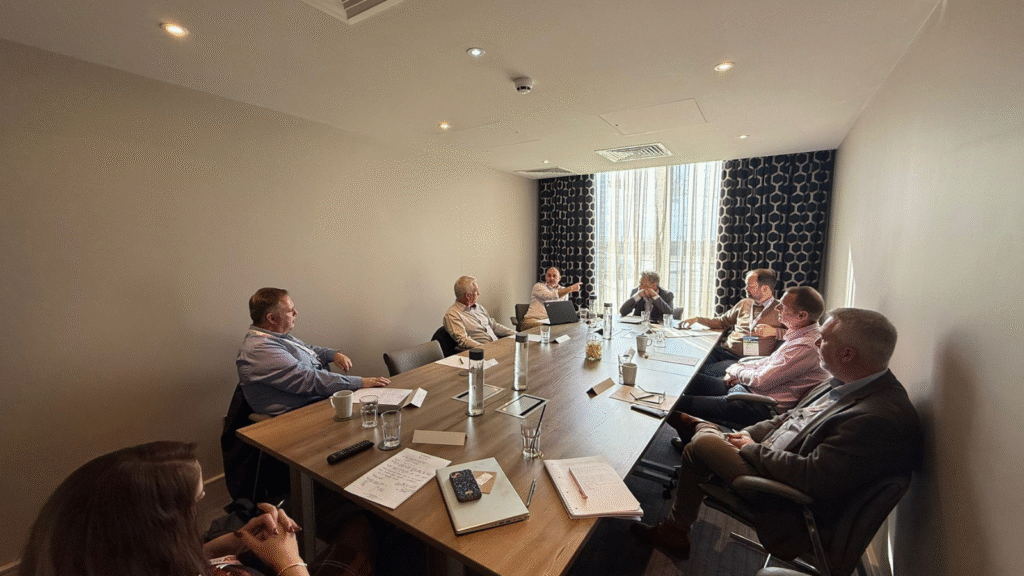
Local authority professionals gathered for an invitation-only roundtable at Strictly Highways to discuss the growing role of Artificial Intelligence (AI) in the highways sector.
With increasing pressure to move beyond pilot projects and embed AI into day-to-day operations, local authorities are beginning to realise its full potential. The roundtable, hosted in collaboration with Gaist, sponsor of our AI Mini-Guide on Road Condition Monitoring (also launched at the event), explored the experiences, challenges, and opportunities local authorities face as they adopt AI-driven tools and processes.
Participants shared insights from their individual journeys with AI. The discussion opened with an introduction from Steve Birdsall, Chief Executive at Gaist on how they have been developing AI for over a decade, primarily in modelling and prediction. They spoke about the value of AI, while stressing the importance of understanding its limitations and asking: “What is the gap we have to fill in here with a human?”
Several attendees echoed the need for greater understanding of what AI can and cannot do. One participant commented, “All I hear is automation and AI” adding it is referred to as “magic bullet that will fix everything.”
Attendees debated the balance between automation and human oversight and a key challenge discussed was the shortage of experienced staff and loss of skills in the sector. One attendee noted, “Knowledge and skills need to come first, before we look at the technologies to pair with that.”
There was also discussion around cultural and operational implications of AI and is AI being adopted to create additional capacity or to reduce staffing levels? As one participant remarked, “AI can do the heavy lifting, but we still need humans to interpret, verify, and act on the insights.”
Others raised concerns about trust and transparency in AI outputs, particularly when systems generate responses from unknown sources. Many local authorities lack the capacity to validate AI results through comparison trials, highlighting the need for accessible, reliable benchmarking information.
The group discussed how AI will inevitably become embedded in everyday operations, but understanding its appropriate use is critical. As one attendee put it, “Currently the term AI doesn’t mean much. Much like magic, it makes things appear.”
Discussions also covered highway inspections and how despite the potential for AI to accelerate inspection processes by pinpointing high-risk areas to be inspected, there remains a requirement for human judgment with AI lacking the ability the ability to siphon inaccurate data.
Participants debated what level of post-processing accuracy is acceptable for AI to have a “net positive” effect on asset management. While many felt that expectations of 100% accuracy were unrealistic, they agreed that risk, trust, and procurement value must all be carefully balanced.
The conversation also highlighted the issue of fragmented innovation: multiple teams trialling similar AI solutions in isolation. Greater collaboration and coordination were seen as key to maximising value and reducing duplication. Financial pressures continue to shape decision-making, with one authority choosing to adapt an immature AI system in-house rather than invest in an expensive off-the-shelf alternative.
Ultimately, participants agreed that the focus should shift from short-term “cashable benefits” to long-term knowledge and capability building. As one attendee concluded, “Good AI brings improvement but poor AI can create risks we don’t yet fully understand.”
(Image – LCRIG)