


We recently surveyed our members about groups they’d like us to start, the problems they’d like solved, and where they could find good practices. We also conducted the most in-depth innovation survey we’ve ever done, with responses from both suppliers and the public sector (mainly councils).
Surprisingly, and overwhelmingly, “something” around AI topped the list in the Innovation survey and also ranked highly in the groups survey. Upon reading the free text comments from members, we found some interesting contextual insights. Comments ranged from wanting to understand how AI can contribute to day-to-day productivity, to how it can help plan services and assist in areas with staffing shortages. For me, there was also a clear desire to move beyond the ’AI solves everything’ panacea. People wanted trusted information.
AI headlines are everywhere – and have been for some years, much like autonomous vehicles, which often dominate the news. Both technologies are beginning to show some real promise. We already work and support partners like Zenzic and have been closely following the CAM trials underway across the country, watching for implications for Highways Services and Transport Technology. There is some pretty headline grabbing news stories about AI – although you do sometimes have to sift through the hyperbole to find facts, not just “myths”.
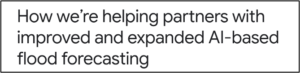 For example, this headline in Google’s November 11th blog post isn’t just hyperbole. Google shares the global work that has been undertaken and evaluated to improve flood forecasting.
Yet, at the recent ITS World Congress in Dubai, I attended a session where a panelist boldly talked about how AI could be used to spot all manner of things in the engineering and highways space and solve many, many issues. I am afraid I did upset him by asking some direct questions that he couldn’t answer, and I suspect he was trying to find a problem to solve without understanding the context. He was also most definitely talking about machine learning, not AI. There are some brilliant thought leadership pieces out there on AI and the problems it “will” solve – high level papers and grand statements about productivity. But too often these are not grounded in tangible evidence. It’s in this space the we, as a sector, are operating in a very unclear environment. I have also seen many frustrated comments on LinkedIn from industry professional irritated by the overuse of the term “AI”. If you’re not an expert, this video provides a useful breakdown of the differences between AI, machine learning, deep learning, generative AI, and more.
 Going back to the comments we’ve received, particularly around Innovation, it is for the reasons above that we will be launching an output focused working group in the new year (read Dan’s blog here). We fully anticipate that it will produce tools, share experiences, and, hopefully bust a few myths!
There are also critical issues in the highways maintenance space that, for now (and perhaps forever), will still rely on humans. I think it’s important that we’re clear about this in our work and understand what “AI” can’t yet do!
Finally, if you’re like me and naturally curious about new things (or even old things – AI has been around for decades), then I recommend some Christmas or holiday reading. “Artificial Intelligence: A Guide for Thinking Humans” is both readable and enlightening, and it also helps set the wider context.
By the way, any mistakes in this article are all mine, not AI. 😊
Paula Claytonsmith, CEO