


This week, I was invited to participate in a behind closed doors roundtable with Lilian Greenwood MP, Minister for the Future of Roads, PAVE UK, and a select group of car suppliers, technologists, thought leaders, and CAM technologists.
The PAVE UK initiative aims to build public confidence in self-driving technology through a programme of education and engagement. This supports the UK Government’s goal of safely deploying self-driving vehicles on the road and establishing the UK as a leader in artificial intelligence (AI). Earlier this year, the University of Warwick established the Partners for Automated Vehicle Education United Kingdom (PAVE UK) with the Department for Business and Trade, the Department for Transport, the Centre for Connected and Autonomous Vehicles (CCAV), and Transport for West Midlands, as its founding partners. We are thrilled to begin discussions with Professor Siddartha Khastgir, Head of Safe Autonomy, about the local roads perspective.
I first met Dr Siddartha at a National Infrastructure Commission (NIC) meeting focused on CAM. He shared my concern that councils, especially highways departments, should be included in the conversation on translating future thinking into practical preparations for a the real-world deployment of CAM technologies. This is the critical part for me – What do our members need to know (or not)! It was for this reason that I initiated a relationship between Zenzic and our organization.
Attending CENEX Expo provided an opportunity to meet with Zenzic colleagues to plan next year’s Sector Insights work and to discuss future developments with Innovate UK CAM colleagues. Our Sector Insights work in 2025 will focus largely on practical solutions for today’s challenges for councils while peeking over the “what’s coming in” technology fence.

CENEX Expo is not an event I’ve attended previously, and I found it interesting to see the range of exhibitors and sessions on alternative fuels, electric vehicles (EVs), CAM technology, hydrogen technology, and Net Zero. The sessions covered diverse subjects, and I briefly listened to a session by the Department for Transport (DfT) on “Replacing Red Diesel,” which was part of a wider discussion on future fuels. It was a real treat to see car suppliers showcasing alternative fuel vehicles, hydrogen fuel vehicles, and new battery technologies.
In addition to the closed roundtable with the Minister, I was also sat on a panel with Sarah Sharples, Chief Scientific Advisor at DfT; Dr Siddartha Khastgir, Head of Safe Autonomy; and David Wong, Head of Technology and Innovation at SMMT. Our discussion centered on building public trust and understanding the emerging landscape of autonomous vehicles (Avs). Sarah was talking from a policy perspective, David from an industry point of view, and I was talking from a local authority perspective, focusing on local roads and their challenges.
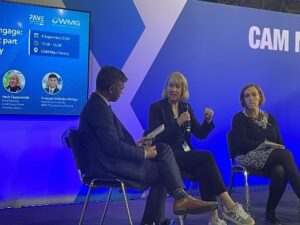
Our panel discussion focused on bringing the public along on the journey with autonomous vehicles (Avs) and building trust in their safety. We explored the various and at times conflicting messages directed at different user groups, such as pedestrians and cyclists but also councils and highways departments. In summary, we all agreed on the crucial need consistent language to effectively address these diverse concerns and build public trust.
Finally, this week I reviewed technical and research papers for the ITS World Congress in Dubai as part of the rapporteur team that Darren from DfT and I are part of. Being part of the volunteer rapporteur team for ERTICOis a brilliant way to gain insight into all the amazing developments happening globally in the ITS space, from urban mobility and CAM to AI, traffic management, and beyond!
Paula Claytonsmith, CEO