

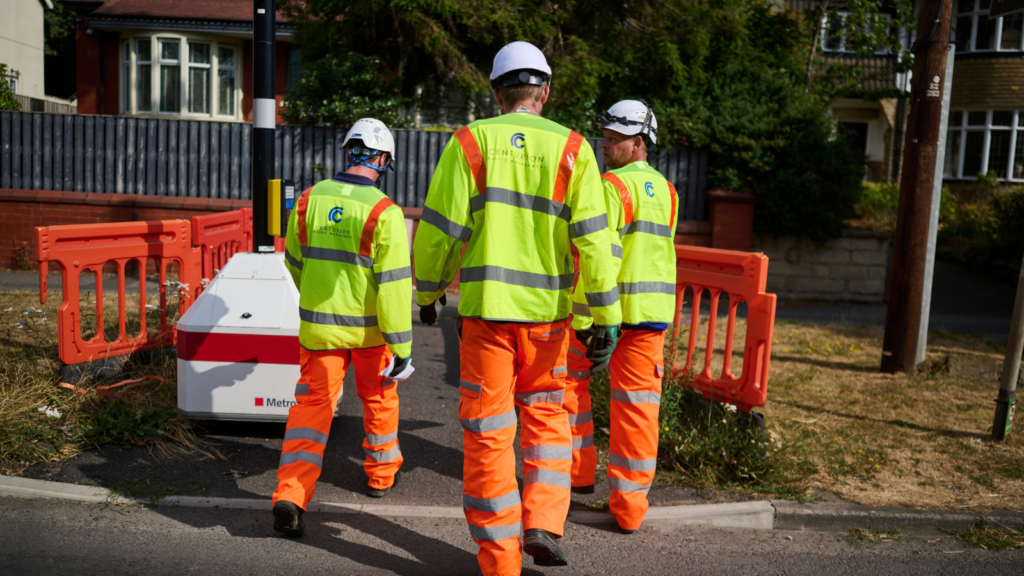
In this member article, Centurion Traffic Management discuss why pedestrian management should be at the heart of every event and roadworks scheme.
From accessibility and safe diversion routes to the needs of wheelchair users, visually impaired pedestrians and families with pushchairs, it explores why effective pedestrian planning needs to be considered from the very beginning of a project, not as an afterthought.
Why we put pedestrian management at the heart of every event and roadworks scheme.
Traffic management is often discussed in technical terms of vehicles, lane closures, temporary signals, signed route diversions and managed traffic flow.
But every roadwork, construction site and event management scheme also shares a space that people need to move through safely and not everybody experiences that environment in the same way.
For pedestrians with mobility issues, wheelchair users, visually impaired, elderly members of the public and parents with pushchairs, a poorly planned pedestrian management scheme can quickly fail and become more than simply an inconvenience. In some cases, it can even create barriers to safe movement and accessibility.
That is why Centurion TM ensures that pedestrian management is never treated as a secondary consideration. It is always an essential part of the early planning process, built into the very first design.
Accessibility is a priority
There is a requirement under the New Roads and Street Works Act to provide safe and practical pedestrian access during works. But beyond legal compliance, there is also a wider responsibility across the traffic management sector to ensure all public spaces remain accessible for people, having a working knowledge of the Equality Act 2010 helps us in manage all users of the network safely.
As we often see, the reality is that for many traffic management operators, pedestrian management implementation is often limited to a few inadequately placed barriers with poor quality signage placed around a site area all delivered quickly, with an assumption that pedestrians will simply work their way around it.
In reality, that casual approach does not help vulnerable people navigate temporary environments.
A wheelchair user may be unable to use a diversion route simply because of uneven surfaces or restricted access widths. A visually impaired pedestrian may rely on consistent layouts, tactile paving and clearly defined walking routes to navigate safely through an area. Someone with limited mobility may struggle with excessive diversion route distances and poorly lit walkways.
These examples are, unfortunately, not that unusual. To resolve this mindset, a people first approach has to form part of every traffic and pedestrian management plan.
At Centurion TM we understand user behaviour and design schemes that keep all road users as close to desire lines as possible. Giving confidence to road users that their needs have been considered and, safe and appropriate control measure implemented. In turn this reflects positively on the contractor responsible for the overall site and the works themselves
Events and Pedestrian Management share similar issues
The same principle applies to event traffic management.
Large public events will naturally disrupt normal pedestrian movement, often introducing temporary barriers, crowd management systems, road closures and diversions alongside time-controlled access routes.
Without detailed pedestrian planning, events can become especially difficult to navigate for vulnerable pedestrians and disabled visitors.
Here, accessible routes, crossing points, viewing areas and safe movement corridors all need to be considered as part of the wider event management strategy, not tacked on as a last minute fix once the layout has already been decided.
Good pedestrian management is about understanding how people actually move through a public space and designing around those needs safely and practically.
Effective Pedestrian Management starts day one
The most effective pedestrian management schemes are always those designed with accessibility as first principles.
That means considering clear signage placement, crossing locations, lighting and pedestrian barrier layouts during the design phase and certainly not waiting until after the event has already started.
It also means understanding the surrounding environment, key access points and the people who use it. A pedestrian management solution outside a railway station or hospital, for example, may require a very different design approach compared to a standard roadside scheme.
At Centurion Traffic Management, pedestrian movements form part of our strategy planning process from the outset. We carefully assess how members of the public will interact with the scheme or event space and develop the ideal traffic and pedestrian management solutions that prioritise their safety, accessibility and practical movement through the site.
Pedestrians deserve more than basic compliance
For us, pedestrian management is not simply about achieving minimum requirements.
It has to be about recognising that roads, pathways and public spaces need to remain as open as possible and usable for everyone, including those who already face additional accessibility challenges.
As Chris Speight, Director at Centurion Traffic Management, explains:
“Good pedestrian management is about people, not just barriers and signage. If somebody is using a wheelchair, a pushchair or navigating with a visual impairment and cannot move safely through a space, then the planning has already fallen short. Accessibility should never be treated as a casual afterthought – it must be a key requirement for every project.”
Because ultimately, traffic management is not only about moving vehicles around safely. It is about protecting and supporting the people using the space around them too.
(Image – Centurion Traffic Management)
LCRIG shares news, announcements, and press releases from our member organisations. Content remains the responsibility of the issuing organisation and does not necessarily reflect the views or endorsement of LCRIG.