

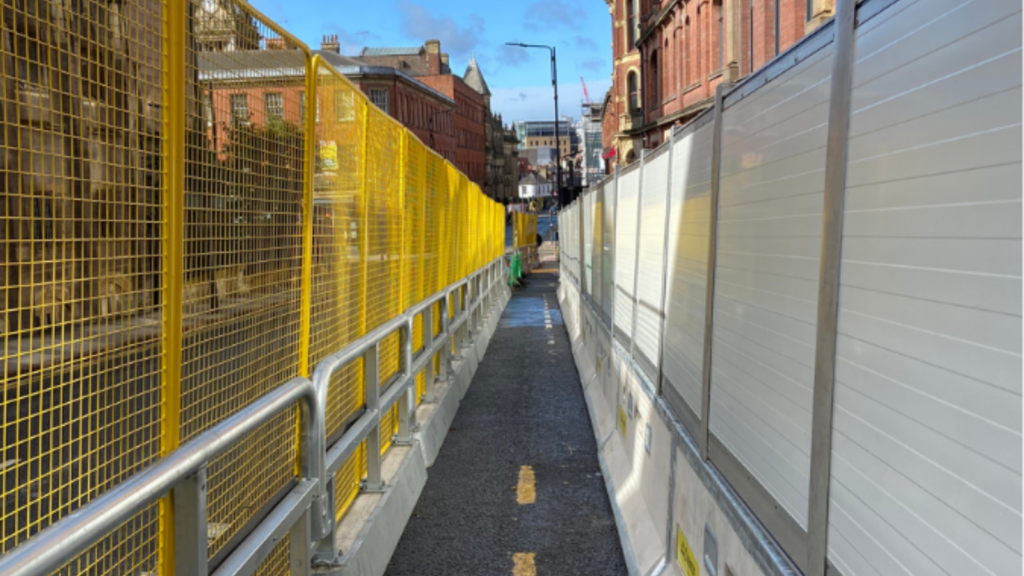
In this member article, Ramudden Urban Solutions explores why the best barrier decisions start with one simple question: What are you protecting?
When planning temporary works, it’s easy to focus on the barrier. But before comparing products, footprints or technical specifications, take a step back and ask something far more important: what are you protecting?
The answer might be a workforce carrying out essential maintenance, school children waiting at a temporary bus stop, pedestrians following a diversion route, cyclists using an active travel lane or members of the public passing a construction site.
Every location is different and every risk is different, which means the level of protection required will be different too. Barrier selection should never be based solely on what is available or cost effective. It should be based on understanding the environment, assessing the risks and choosing a solution that provides the appropriate level of protection.
Why high-performance barrier systems matter
Standard barriers remain the right choice for many applications, providing effective delineation and pedestrian management where the level of risk allows. However, some environments demand more.
As urban environments become busier and temporary works become more complex, the need for higher levels of protection has never been greater. That’s why Ramudden Global developed its range of high-performance barrier systems, helping customers choose engineered solutions where standard delineation alone may not be enough. Today, Ramudden Urban Solutions brings this expertise and product range to projects across the UK.
Where temporary works are located alongside live traffic, where pedestrian or cyclist numbers are high, or where the consequences of vehicle intrusion could be significant, a high-performance barrier system can provide a more appropriate level of protection.
Traffic speed, available space, surrounding hazards, pedestrian and cyclist movements and, most importantly, what sits behind the barrier should all be considered. These factors help determine the level of protection required and ensure the chosen solution is appropriate for the risks present on site.
Which high-performance barrier system is right for your site?
At Ramudden Urban Solutions, our high-performance barrier range includes Urban Barrier and SVEA Barrier. While both are engineered to provide enhanced protection, they have been developed for different applications and operational requirements.
Urban Barrier
Urban Barrier has been designed for busy urban environments where pedestrians, cyclists, vehicles and temporary works often need to operate safely within the same space.
With its compact 300 mm footprint and no pinning required, Urban Barrier is well suited to locations where space is limited and preserving valuable room for pedestrians, cyclists and operational activity is important.
It is ideal for creating protected pedestrian routes, temporary footways and secure work zones, while also supporting active travel initiatives by providing clearer separation between pedestrians, cyclists and live traffic.
Whether protecting a temporary bus stop, segregating a cycle lane or creating a safer route around roadworks, Urban Barrier helps deliver robust protection without compromising valuable space.
SVEA Barrier
Where a project requires certified vehicle restraint, SVEA Barrier provides an engineered solution with proven performance.
Crash-tested to BS EN 1317-2, SVEA Barrier delivers certified vehicle restraint for higher-risk environments where the consequences of vehicle intrusion could be significant.
SVEA Barrier can also be combined with sound panels to support both site protection and noise reduction, helping to reduce the impact of temporary works on nearby residents, businesses and public spaces.
Its proven impact performance makes SVEA Barrier suitable for locations where certified vehicle restraint is essential to protecting people, infrastructure and critical assets.
The right barrier starts with the right question
There is no one-size-fits-all approach to barrier selection. The right solution depends on the environment, available space, traffic conditions, pedestrian and cyclist movements, and the potential consequences of vehicle intrusion.
Urban Barrier and SVEA Barrier have been engineered for environments where the level of protection matters most. Whether supporting active travel routes in busy urban spaces or providing certified vehicle restraint in higher-risk locations, the priority is always the same: protecting what matters most behind the barrier.
Because the best barrier decisions do not start with the product. They start with one simple question:
What are you protecting?
(Image – Ramudden Global UK)
LCRIG shares news, announcements, and press releases from our member organisations. Content remains the responsibility of the issuing organisation and does not necessarily reflect the views or endorsement of LCRIG.