

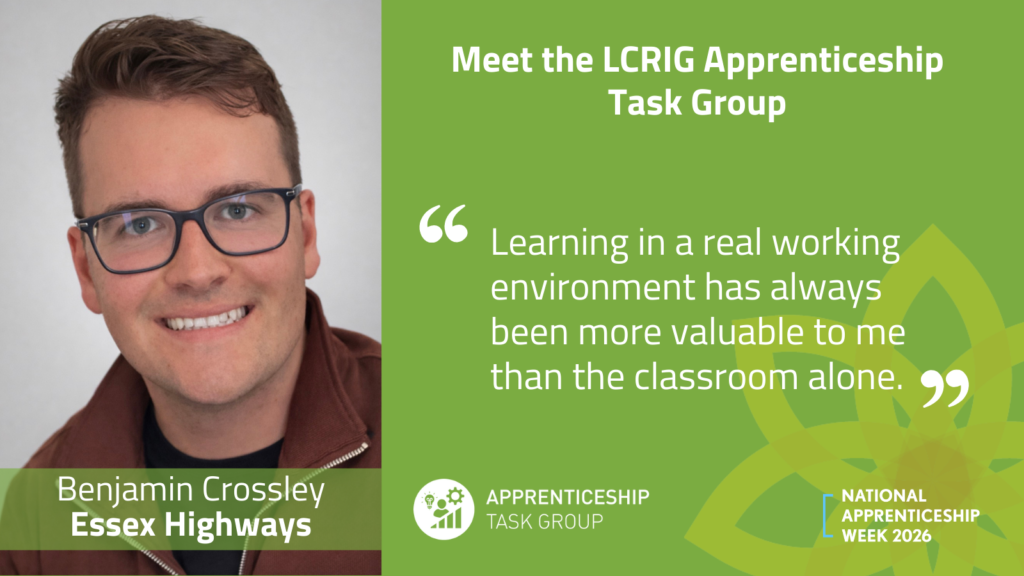
Continuing our National Apprenticeship Week series, we’re pleased to introduce Benjamin Crossley, an Engineer in Development Management at Essex Highways. Benjamin shares how his father’s career inspired him to pursue an apprenticeship, how he balances work and study, and his advice for anyone considering an apprenticeship in the highways sector.
Q. What inspired you to choose an apprenticeship over another career or education pathway?
A. I chose an apprenticeship because it gave me the opportunity to work while gaining hands on experience, alongside studying at college and university. For me, learning in a real working environment has always been more valuable than learning purely in a classroom. My dad was also an apprentice when he was younger, and seeing how that shaped his career definitely influenced my decision. The apprenticeship route felt like the best way to build practical skills, earn a qualification, and start progressing in the industry straight away.
Q. How do you manage balancing work responsibilities with training and study commitments?
A. Balancing work and study is one of the biggest challenges, and time management becomes essential. I’ve learned to prioritise the most important tasks, whether they’re university deadlines or work commitments, and break everything down into weekly and daily to do lists. There’s a real sense of achievement when you tick things off.
I’ve also been incredibly lucky to work with supportive teams across Ringway Jacobs. Their understanding and encouragement have made a huge difference, helping me manage my workload and succeed in both areas.
Q. How has being part of the LCRIG Apprenticeship Task Group supported your personal and professional development?
A. Being part of the LCRIG Apprenticeship Task Group has allowed me to support other apprentices, share my experiences, and contribute to improving the apprenticeship journey for others. It has strengthened my networking skills and opened my eyes to the wide range of apprenticeship opportunities within the highways sector, not just civil engineering. It’s helped me grow in confidence and understand the industry from a much broader perspective.
Q. What advice would you give to someone considering an apprenticeship in the highways sector?
A. Although the workload can be higher than a standard degree, the experience you gain speaks volumes in the industry. By the end of your apprenticeship, you’ll have both qualifications and real-world experience, a combination that employers really value.
The highways sector offers a long term, stable, and rewarding career. In my opinion, it’s one of the best areas within civil engineering to be involved in. I’d strongly encourage anyone to consider an apprenticeship, especially through the Ringway Jacobs apprenticeship programme, which has given me incredible opportunities and support throughout my journey.
A huge thank you to Benjamin for sharing his apprenticeship journey with us.
Stay tuned as we continue to introduce more members of our Apprenticeship Task Group throughout the week.
If you’re an apprentice and would like to stay updated on news and initiatives from the Task Group, subscribe here.