

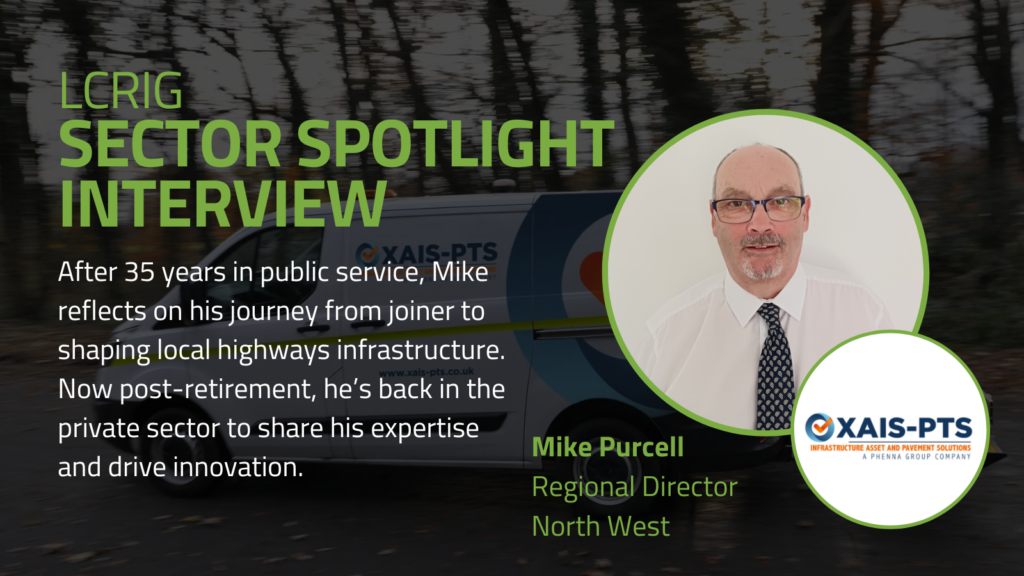
We recently caught up with Mike Purcell, now working with XAIS-PTS, and one of a growing number of professionals returning to the highways sector after retirement. Mike shared how he unexpectedly found his way into the industry during Margaret Thatcher’s era, what drew him back, and his thoughts on the sector’s future. He also took a moment to reflect on the early days of LCRIG and key moments from his journey.
Can you tell us how you came to work in highways?
“It wasn’t a path I initially planned. I started out as a trained joiner and completed an apprenticeship in the trade. But during the economic downturn of the 1980s, opportunities in construction dried up. I began working at Bolton Council in the early ‘90s as a Highway Inspector. That role sparked my interest in the wider field, and I went back to college to study civil engineering, eventually earning both ONC and HNC qualifications.
From there, I progressed through various positions at Bolton, including Technician and Technical Supervisor. In 2004, I moved to Wigan Council as a Technical Manager, where my responsibilities expanded to include asset management.
Looking back, what are some standout moments from your career?
I’ve been fortunate to be part of several significant initiatives. A major one was on the panel for the HMEP reviews, following a review conducted at Wigan Council. That work really shaped how authorities approach maintenance planning.
Another highlight was chairing several Greater Manchester Combined Authority (GMCA) highways collaboration group meetings. Together, we developed a gap analysis and strategic plan to meet the Department for Transport’s Incentive Fund criteria. After a long tenure at Wigan, I joined Transport for Greater Manchester in 2017 as their Key Route Network Asset Manager continuing to push collaborative approaches in the region.
As a longtime advocate for LCRIG, can you tell us about your involvement with the group?
I’ve been involved with LCRIG from its inception. I was in the room at the first meeting at South Shore, Blackpool, back in 2013, with LCRIG’s President, Will Britain, and colleagues from half a dozen other local authorities. That early collaboration laid the foundation for what LCRIG has become today.
Over the years, I stayed closely connected, especially through initiatives such as Project 30 and Project Amber in Blackpool. I often represented Wigan Council at LCRIG meetings, and later, as part of the GMCA, I pushed for greater involvement by Greater Manchester’s LHA’s. I’ve always considered industry collaboration as key to driving consistent and effective highway asset management.
How has asset management evolved for local authorities over your career?
When I first started working in asset management, it was a relatively new concept. Local Highway Authorities (LHA’s) were required to undergo a steep learning curve to define the role of Asset Managers and establish effective asset management plans and strategies with the requirement to continually update them.
We also had to bring political leaders on board to support this shift, especially with the introduction of the DfT’s Incentive Fund. Over time, the sector matured. Now, data-driven decision-making and innovation are front and centre. It’s all about making sure we get the best value out of limited funding for maintenance.
What do you think has been the biggest impact on highways during your career?
The introduction of the Incentive Fund in the 2015 Government Comprehensive Spending Review (CSR) was a game-changer. It introduced a new level of accountability and pushed authorities to become more efficient. But it wasn’t easy – completing the questionnaire and navigating the complexities of the fund was challenging. Collaboration among local authorities, was crucial for securing funding and implementing best practice consistently.
Additionally, the DfT introduced several additional competitive funding streams such as the Challenge Fund. These bidding funds took a lot of resources to complete and staff time and knowledge to complete these were very limited. However, the financial rewards if successful were helpful in securing highway schemes which otherwise would not have been delivered.
More recently, there’s been the DfT’s announcement around the retention of 25% of funding.
Why have you returned to the sector, and how did your involvement with XAIS-PTS come about?
I saw a growing gap! A lot of experienced people were retiring, and there’s a real risk of knowledge and skills being lost. I’m passionate about mentoring and making sure we pass on what knowledge we’ve learnt to the next generation.
I already had a working relationship with XAIS-PTS, particularly when representing Greater Manchester on the evolvement of PAS 2161. Having once been an end-user of data-driven insights, I have a wider awareness of the full data processing cycle from the survey providers’ perspective and how important data driven decisions are to LHA’s generally.
XAIS-PTS is a very forward- thinking, data driven company and I’m particularly passionate around developing innovative technologies to progress asset management.
What do you think will be the next big thing in highways?
I’m excited by the potential of emerging technologies. AI is going to play a crucial role in shaping the future of the highways sector, and another reason to come back into the industry with XAIS-PTS. It will be interesting to see how AI in surveying technology and minor works maintenance such as managing trip and slip claims will prove useful in defending claims through data analysis and evidence gathering.
I’m also excited to see how drone technology could help revolutionise infrastructure inspections that are difficult to access, such as bridges. I remember the late Steve Berry OBE saying on a Challenge Fund scheme visit in Wigan around bridge maintenance: “One day we will have drones instead of scaffolding.” It’s happening!
What would you say to young people considering a career in highways?
Go for it! I’d encourage any young person considering a career in highways to look at the sheer diversity of roles on offer within the sector, be that with Local Government or with the private sector.
The progression of AI globally and within the sector needs more young people to bring and share their current skills along with their enthusiasm for learning and progressing within the sector. Also, they will have the opportunity to study for industry qualifications whilst learning on the job.
As an industry, we need to continually pass on our knowledge and experience to budding Civil/Structural Engineers in our sector and ensure long term engineering stability in maintaining the UK’s highway infrastructure.
Thank You to Mike Purcell
A huge thank you to Mike for sharing his story, insights, and wisdom from a career dedicated to public service and innovation in highways.
To learn more about XAIS-PTS and their asset management technology, visit their website. You can also see their innovations firsthand at the Innovation and Learning Festival, where they will be exhibiting at indoor stand number 48.
Images: XAIS-PTS