


As 2024 draws to a close, this marks my final View from the Top of the year. Throughout the past 12 months, I’ve focused on sharing policy insights and perspectives shaped by my work. So, it feels fitting that this final reflection should tackle what’s being hailed as the “biggest transfer of power out of Westminster.”
If you keep an eye on policy, hold a national role, or have a general interest in politics or government strategy, you’ll know that this week’s hot topic is the release of the English Devolution White Paper.
At its core, this white paper outlines the government’s vision for empowering England’s regions by shifting decision-making closer to home. Local government is set to undergo significant changes, with devolution expanded to more areas. Mayors will gain additional powers, alongside a push for standardisation that aims to make devolution agreements more consistent across England.
Rather than diving into the origins or finer details of the white paper, I want to focus on what it means for our sector. As readers know, I have a habit of closely following government policy and waiting for its full implications to emerge. But even at this early stage, it’s clear that this is a landmark moment, despite some of the gaps in detail.
What Does It Mean for Us?
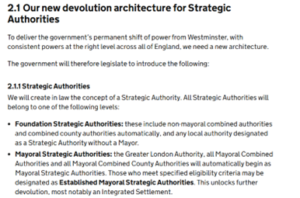
In the short term, there won’t be major changes—at least not for suppliers or highways authorities. However, the government’s intent is clear: they plan to create a “new devolution architecture,” as shown in the extract below.
 Thanks to the insights of colleagues at the LGA, here’s a quick summary:
Mayoral Strategic Authorities will coordinate a Key Route Network (KRN) on behalf of the mayor. This ensures the most important local roads are managed strategically.
Mayors will hold a Power of Direction over these networks to deliver their Local Transport Plans. The effectiveness of this power will be reviewed two years after implementation.
Responsibility for local roads will remain with constituent authorities unless alternative arrangements are agreed locally.
The government will encourage Strategic Authorities to streamline arrangements across their regions, such as by standardising highway design standards.
While these steps build on existing structures, they lay the groundwork for more significant future changes. Notably, the funding mechanisms for this new devolution model remain unclear. We’ve already seen tensions between funding layers and delays in current devolution deals, but that’s a discussion for another day.
For now, the delivery of local roads won’t change drastically. However, the restructuring of councils could lead to significant shifts down the line.
Looking Ahead
Reflecting on past experiences with previous Labour administrations (and no, I’m not that old!), there’s reason to believe a structured framework will follow. Historically, we’ve seen stringent processes emerge to ensure delivery, including the possibility of strong sanctions for poor performance. It’s not hard to imagine underperforming councils being pushed toward combined authorities or facing heightened scrutiny under mayoral targets.
While this year-end reflection may not be festive, I’m genuinely excited about what 2025 has in store. Thank you for following my updates throughout the year. I wish you all a healthy and happy festive season, whatever you may be doing.
I look forward to seeing as many of our members as possible in the new year!
Paula Claytonsmith, CEO