



Throughout last year (and the year before), DfT began its work talking with different councils, suppliers and industry professionals about introducing a new specification for Road condition monitoring (RCM) data.
This is the data that councils are required to submit formally under the “single data list” requirements. These requirements are bound up in other legislation, but also form part of a negotiated process that LGA played a critical part in to reduce burdens on Councils.
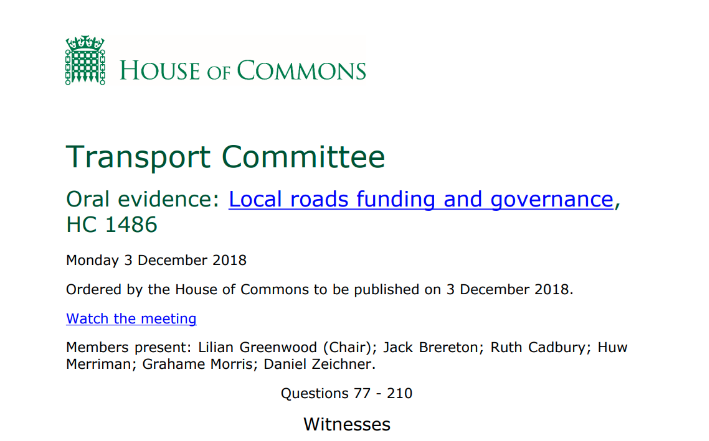 The origin for the change in Road Condition monitoring first came after the Transport Committee “Local roads funding and governance” in 2018. This committee sought and heard evidence from a range of selected witnesses. I was one of those witnesses. At the time I was working in a different role in the private sector. However, that being said, regardless of the role I was very passionate about DfT considering all other forms of technology to monitor roads. I wasn’t the only person, there were many others calling for DfT to consider the role of newer forms of technology or alternative processes that councils could use.
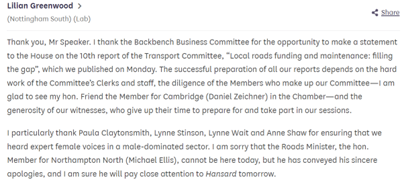 After the Committee concluded its many meetings, the Committee Chair took the opportunity to specifically thank some witnesses and highlight the women that spoke.
DfT responded to government on a range of areas that should be considered. One of those areas being Road Condition monitoring.
I have long been a believer, and perhaps it comes from a previous lobbying and policy background before I joined the highways sector, that councils should be encouraged to consider new ways of working to improve service delivery.
Returning to the changes planned for reporting, DfT have since listened to councils and suppliers through surveys, workshops organised by LCRIG, attendance at events including previous Innovation Festivals and Strictly Highways, supplier workshops and individual meetings. I think credit must go to Laura Murphy at DfT for diligently trying to reach as many people as possible at the start of the process, through the process and by being open to people’s views.
Last year DfT appointed BSI to undertake and create a PAS (2161) for the new standard and Alex Wright from TRL was appointed as a technical author. Following these appointments, a rigorous process has been established that included a Steering Committee made up of councils, technical experts, technology, asset management suppliers that provide differing forms of road condition, LCRIG (me) and others. An onsite review of differing technologies that required consideration by TRL was also undertaken and also a review of output impacts that still give DfT the information they require.
The Steering Committee met over an extensive number of hours in December 2023, reviewing the technical report, peer reviewing comments with group acceptance or decline of changes. There have been debates, discussion, clarifications, additions and revisions – it was a very intense process I can say.
I can truly also say that given such a diverse range of steering committee members drawn from so differing many quarters, that the process has been thorough, but also that we have also worked well together, public versus private interests. BSI, DfT and the Technical Author, have really had a very hard task, but again I have seen a real united front from DfT and the Technical author to try and increase, but keep comparability of different technologies.
The final stages of new reporting are starting to get closer, and this includes a public consultation stage for BSI PAS 2161, Road condition monitoring (RCM) data – Specification, this was released 10th April 2024 and will close on the 7 May 2024. The link below is where councils, suppliers and interested parties can view and comment on the Standards Development Portal website and comment on the BSI Public Consultation draft.
To recap, the BSI Public Consultation of PAS 2161 closes at midnight, UK time, on 7 May 2024. Only comments submitted via the Standards Development Portal website will be accepted and no comments submitted after that date will be accepted. In addition, please make sure that your organization’s comments are collated and submitted onto the Public Consultation website by one person only.
Those wishing to comment will need to register on the site in order to submit comments, but it is free to register. To register, please click on this link.
There is a guide to using the Standard Development Portal website that can be accessed here.
Paula Claytonsmith, Chief Executive