


 This week has certainly been a bumper week for news, controversy, and mixed messages from the Government.
First out of the trap this week was on Sunday 17th March, where the Government released further information on key points outlined in last October’s Plan for Drivers. The key tenets of Sunday’s announcement are below (extract source: statement to Parliament). A few areas that received the most attention were LTNs and a call for evidence on council’s ability to “profit” from enforcing traffic. The announcement also had some heavily loaded language, which I know for me made for uncomfortable reading. But there were other positive funding announcements that followed as the week has gone on, I comment on these much further below.
- New guidance on Low Traffic Neighbourhoods – following the recent LTN review, this sets out the requirements on local authorities, including particularly that, via engagement and consultations, an authority should be confident that a scheme is capable of carrying the support of a majority of the community before introducing it.
- 20mph speed limit guidance – strengthened guidance restricting 20mph limits to where they are sensible and appropriate, not on all roads indiscriminately, and with safety and local support at the heart of the decision. Other factors we would expect traffic authorities to consider include journey time, the needs of all road users, and impacts on the local economy.
- Call for evidence on restricting a local authority’s ability to profit from enforcing traffic restrictions – seeking evidence on the way local authorities carry out enforcement and how any surpluses generated should be used.
- Bus lane guidance – ensuring they only operate when it makes sense. For example, when traffic is heavy enough to delay buses.
- Consultation on allowing motorcycles to use bus lanes by default – so journeys are quicker for those who choose 2 wheels, a further initiative to reduce congestion and speed up journey times.
- Lane rental schemes guidance – making it easier for councils to charge utility companies who slow drivers when conducting street works, and allowing the funds generated to be used to repair potholes.
- £50 million investment to upgrade traffic signals – £30 million to replace outdated equipment, and £20 million to reduce poor traffic light performance through innovative technology that responds to live traffic conditions, for 80 local highway authorities across England to improve journey times and reduce congestion caused by red lights
- Consultation on removing the right of uninsured drivers to claim compensation for property damage – a matter of fairness for law-abiding road users, and something that we can now do having left the European Union.
- Noise camera research – showing local authorities the success of this technology to secure evidence to prosecute those who have illegally modified their vehicle’s exhaust.
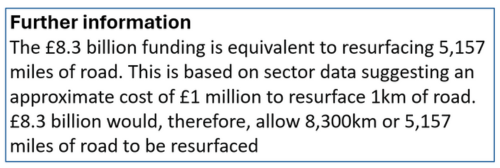
On Tuesday, 19th March the Asphalt Industry Alliance released its much-awaited annual ALARM survey. This year there is a staggering assessment that the backlog has increased from £12bn to £16bn, with additional stats that showed some stark challenges facing industry and councils alike. Interestingly, I’m always drawn back to the DfT statement below, when there is a government response to funding. The statement made is the one in the box below, and the 5157 miles (in my view), probably not the best statistic or number to use because if read at a glance it equates to a medium size county network…
Next up, on Tuesday, was the DfT announcement of a £38 million boost for safer roads across England to support local councils deliver life-saving improvements on high risk roads in England. I know for colleagues at the brilliant Road Safety Foundation, led by the wonderful Dr Suzy Charman, that they have worked tirelessly to increase funding over several years now, so congratulations to DfT and RSF colleagues.
Then on Wednesday, the big news for an area of work we’ve been heavily involved with, was the Signals Funding. It’s fair to say that the successful signals funding for 2021, and the evidence this process gave to DfT was a significant factor in the biggest ever package being announced last year (and confirmed this year) under the Plan for Drivers. In 2021, £15m was awarded to 39 authorities who between them delivered 232 schemes that created an average of 8-12% improvement in journey times. In addition, the data from council submissions in 2021 allowed LCRIG/TTF and DfT to gain a granular insight into issues such as obsolescence, inefficient signals and 3G switch off challenges. The insight into the obsolescence challenge faced by councils and inefficient signalling is exactly why the Green Light Fund and Traffic Signals Obsolescence Grant came into being.
This means that with that evidence, a case could be made for a significant grant to tackle both issues resulting in £70 million being set aside. With LCRIG’s relationships with councils, and working closely with DfT, we were able to contact every eligible council and encourage them to apply, webinar support was created, an additional dedicated support email distributed to the sector and FAQs updated weekly. I’m hugely proud of the collaborative partnership between ourselves, councils and the supply chain that demonstrates the power of collaboration across multiple partners. The next part of the funding will be the Intelligent Traffic Management Fund, a £20 million challenge fund to deploy advanced technology for traffic signals, making use of machine learning and artificial intelligence (AI) to optimise traffic flow and balance traffic across wider areas. This will open next month for submissions, but further guidance can be found on the TTF signals funding page here.
So, in conclusion, a very hectic week for us, but a hugely exciting one too!!
Paula Claytonsmith, Chief Executive