

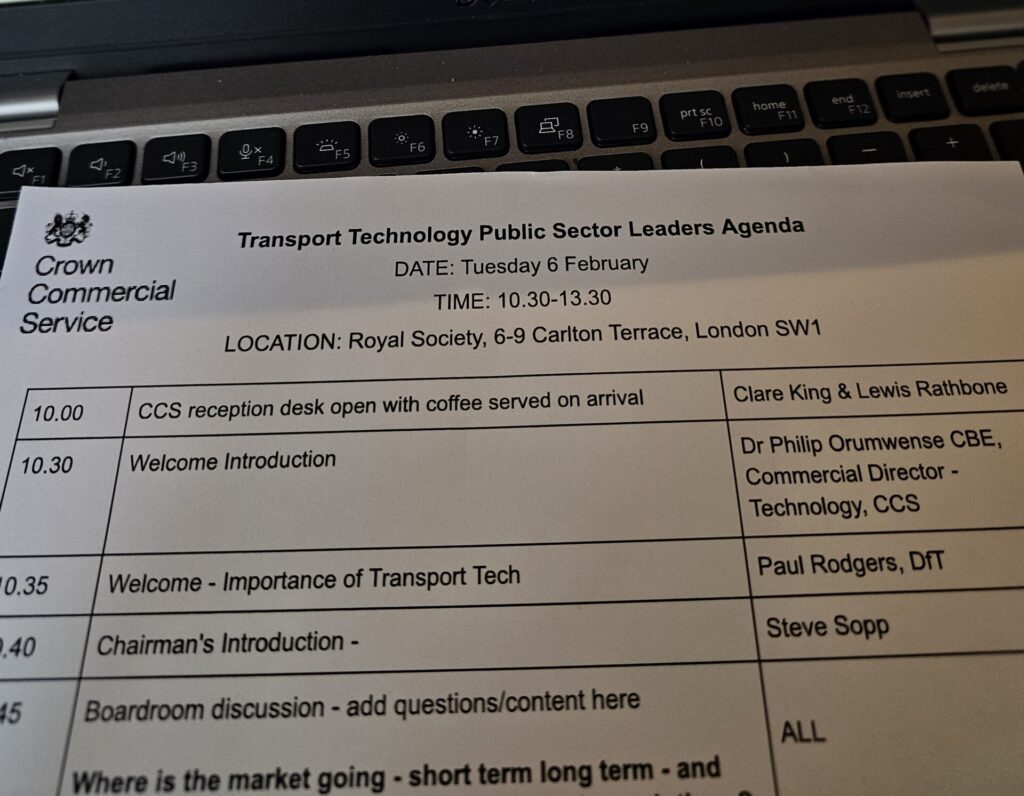
This week I attended a session led by colleagues at Crown Commercial Services (CCS).
The session titled “Transport Technology Public Sector Leaders” was to bring about high-level discussions with key industry leaders and influential players. The meeting started with an enthusiastic plea from Dr Philip Orumwense, CBE and Commercial Director – Technology CCS. The plea, or rather request for input, was around innovation, procuring that innovation and how to encourage greater numbers of innovative SMEs into the Supply Chain, along with frank discussions about what could be learnt for future CCS activity and support.
There were a range of public sector linked organisations and representatives from various parts of DfT, National Highways, HS2, Rail, TfL, a sub-national transport body, us, and others. Steve Sopp, Senior Category lead for Transport Technology and someone whose name should be familiar in relation to our journey on the Innovation Procurement System led the session. It was during the group discussions that I felt proud talking about where the LCRIG Innovation Procurement System had come from, its early germination stemming from the frustration of councils wanting to buy innovation and innovators wanting to supply their innovation but with no route to sell through.
We have come a long way, with the journey still ongoing, and soon we will be opening new categories for the IPS. It has been working with Steve and his colleagues we have all learnt a huge amount. Not just about the art of the possible, but also the legacy of existing ways of doing things and how this has unintended consequences for procuring innovation. The IPS is a hugely innovative piece of thinking, thanks to Martin Duffy, the grandee of the vision and the support we have had from Steve and other CCS colleagues who have been immensely powerful in their support. Bringing together an IPS is not just about the route to markets, it also gives us fascinating insights into supplier and LA demand too.
There was a lively discussion around the barriers not just for innovative companies, but also the risk aspect for public sector organisations (real or perceived). When talking about procuring innovation, one contributor used the analogy that they “wanted to buy a loaf but it was a slice they were dealing with after procurement (Sic).” This is something we see from the insights we get from councils, but also from suppliers – procurement can force artificial demarcations or stifle things (caveat: not in all cases).
I highlighted the challenges faced by SMEs, and certainly many of our SME members do find real barriers not just to entry, but also unwieldy procurement systems that place a bigger burden on them. This is not to say that larger suppliers do not bring innovation into their work, but the wider discussions were around bringing innovators to the market. Transport Technology encompasses such a huge area, and this will only increase with new data models, sensors, advanced digital and for me does not just sit in a neat box of the traditional ITS space. At LCRIG we are seeing greater numbers of new (and existing) members bringing transport technology into the asset management and maintenance space and vice versa.
It is fair to say that in four hours we only surfaced some of the challenges being faced by the public sector, innovators, SMEs, and larger entities. I was heartened by Dr Philip Orumwense CBE’s keenness to show that CCS are listening. With the new Procurement legislation upon us that flexibility is necessary in any new world order of procurement – my words not his. We spoke at length after the session about barriers to overcome but also successes that could be shared and we agreed to meet further to discuss these barriers.
For me, innovation is not just about ways of working, but also about suppliers and innovators in that chain, and that you cannot do any of this without routes to markets or ways of buying that help this to happen. That being said, there is an equal challenge in that too much flexibility in the new future procurement space could make it even harder for innovators to get their voices or products seen…we shall see on this point. But in the meantime, with our partnership with CCS and our DNA to encourage sharing of innovation we will be well placed to sign post people and support innovation adoption.
Paula Claytonsmith, Chief Executive