

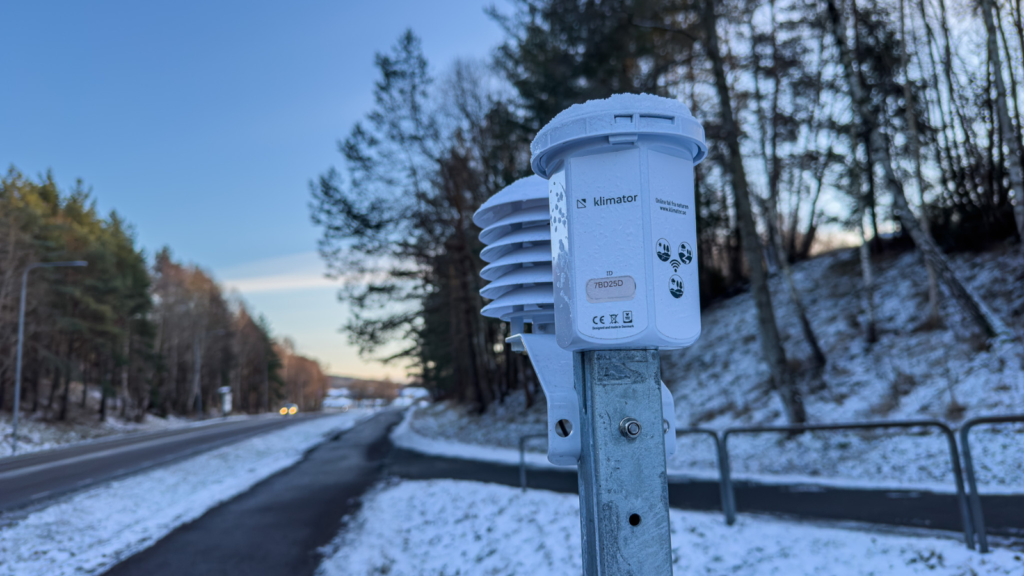
The recent seminar hosted by Rennicks and Klimator provided invaluable insights into the role of Big Data and IoT in winter maintenance. Robert Tait from Rennicks, alongside industry leaders Søren Pedersen from Klimator and Ketil Dahl from Mesta, shared practical examples and emerging advancements aimed at improving winter road safety, efficiency, and sustainability. Here’s a look at the key highlights and takeaways from the seminar.
1. Harnessing Real-Time Data and IoT for Precision and Efficiency
Søren of Klimator introduced attendees to advanced road weather intelligence powered by Big Data and AI modelling. He showcased how IoT devices can capture hyper-local data, revealing microclimatic variations across small road segments. This granular data enables road operators to precisely forecast and address varying conditions, such as frost or rain, within specific areas. Søren emphasised that this technology doesn’t just enhance safety; it also allows for significant resource optimisation, reducing the need for blanket treatments by tailoring responses to actual conditions
2. Dynamic Salt Application for Reduced Environmental Impact
One major highlight was the demonstration of dynamic salt application. By using salt spreaders (connected by GPS) that adjust the amount and type of treatment based on real-time data, winter practitioners can achieve up to 50% savings on salt usage. Søren showed how data feeds directly into the spreader’s system, allowing it to apply the exact dosage needed for each specific road segment. This technology brings winter maintenance closer to a model of precision similar to the agricultural sector, where fertilisers are selectively applied
3. Real-World Implementation
Mesta’s Journey with Smart Winter Operations: Ketil Dahl from Mesta, Norway’s largest O&M contractor, discussed the organisation’s journey in adopting Big Data and IoT for winter operations. With thousands of drivers and vehicles across Norway, Mesta’s approach focuses on incrementally integrating technology to enhance operational efficiency and environmental responsibility. Ketil emphasised that while technology advancements can rapidly change the winter maintenance landscape, the shift also requires a gradual learning process for drivers and operational staff.
Mesta’s collaboration with Klimator and BM Systems has allowed them to implement a fully digital workflow. This includes on-board vehicle pads connected to operational systems, which deliver real-time production data back to the customer, ensuring transparency and precision in every treatment decision.
Case Study: Blackpool’s Transition to Data-Driven Winter Maintenance
Robert Tait from Rennicks presented a compelling case study on Blackpool Council’s swift adoption of sensor-based winter maintenance. Blackpool initially relied on weather data from neighbouring areas, often resulting in generalised and less precise treatments. However, with the support of Rennicks and Klimator’s advanced sensor network and data platform, Blackpool gained access to real-time, hyper-local weather insights tailored specifically to its road network. This shift enabled Blackpool to implement a more targeted approach, applying treatments only where and when necessary, which significantly improved road safety and operational efficiency. Robert highlighted how this case demonstrates that even local authorities with limited prior infrastructure can quickly benefit from IoT-driven, data-centric winter maintenance solutions
4. Challenges and Future Directions in Winter Maintenance
The speakers addressed some of the challenges in adopting new technology in winter maintenance, particularly in adapting traditional contract structures and standards. For example, Ketil highlighted the need for road authorities and contractors to redefine quality standards and business models to support a data-driven approach. Norway’s approach involves a shift to performance-based contracts, where up to 30% of contract evaluations consider environmental impact, highlighting the push for sustainable winter maintenance practices
5. Innovative Solutions on the Horizon
Attendees were given a glimpse into the future of winter maintenance, including trial projects integrating advanced AI to further refine treatment processes. Søren previewed “seeing salt spreaders” equipped with lasers and cameras, allowing them to adapt dynamically to changing road conditions mid-operation. While this technology is still in early development, it represents a step toward autonomous treatment vehicles, potentially transforming the winter maintenance industry over the coming years.
Realising the Benefits of Digital Transformation
This seminar highlighted that while Big Data and IoT have already made substantial impacts, realising the full potential of these technologies requires collaboration, ongoing adaptation, and commitment to digital transformation. From case studies like Blackpool Council’s swift transition to a sensor-based winter maintenance system to Norway’s ambitious goals for sustainable, tech-driven operations, the path forward is clear: embracing technology can lead to safer roads, lower costs, and a more sustainable approach to winter maintenance.
Interested in learning more?
If you missed the seminar or would like to revisit these insights, please contact Rennicks for a copy of the presentation.
Image – Rennicks.